
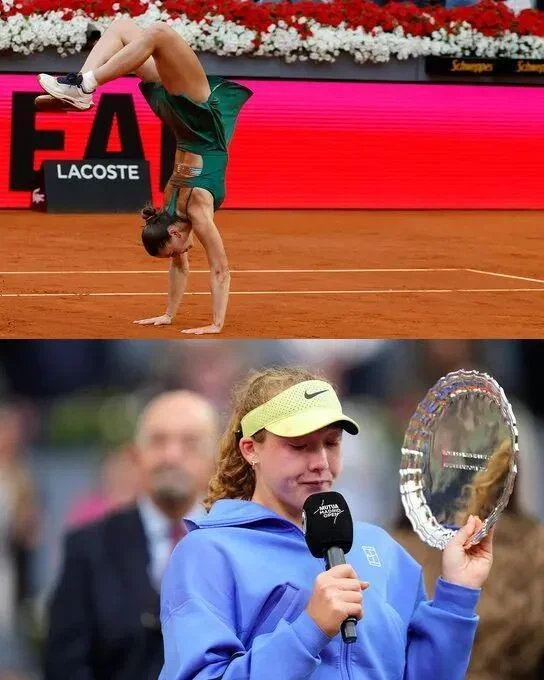
A new champion emerged at the WTA 1000 Madrid Open, as Ukrainian player Marta Kostyuk defeated Mirra Andreeva 6-3, 7-5 in a tense final that carried the weight of an on-court “Ukraine vs. Russia” narrative. The matchup highlighted contrasts far beyond the score: Kostyuk, at 23, is a slightly more seasoned competitor, while the newly turned 19-year-old Andreeva entered as the No. 9 seed against an opponent ranked outside the top 20.
When the match ended, two dramatically different scenes unfolded. Kostyuk celebrated by performing a difficult backflip to the roar of the crowd, while Andreeva broke down in tears during her runner-up speech as she thanked her team.
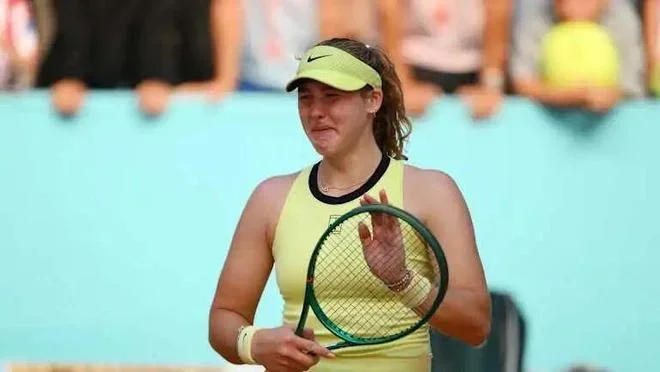
Professional sport never hides its cruelty: the winner basks in glory, the loser plunges into the opposite abyss. This stark emotional contrast serves as another reminder that beyond tactics and technique, elite tennis is also a battle of emotional control.
Andreeva’s talent is undeniable. She shot to fame by winning two WTA 1000 titles last year as a minor, but her frequent emotional outbursts on court have also become a defining trait. She is known for crying during matches and struggling to contain her frustration, not because she lacks the desire to win, but because she wants it too intensely. In her winning matches in Madrid, there were moments where, after being chased by an opponent, she would shout, “I’m going to lose” or “I’m not a champion.” Only after advancing to the next round would she break down in tears of relief.
For Andreeva, losing feels like the end of the world. She admitted after the final, “Sometimes I see other players who can smile right after a match even if they lose. I don’t understand how they do it. I wish I could do that.”
This is Mirra’s current struggle: when the weight of emotions exceeds the match itself, talent becomes a liability. For a teenager just turned 19, learning to coexist with failure and keeping emotions from hijacking performance may be more urgent than any technical refinement.
Kostyuk, as the winner, might offer some answers. She, too, gets emotional on court—tennis involves too many high-stakes moments that demand enormous mental energy. In a post-match interview earlier in the tournament, she shared her approach: changing her mindset about tennis and seeking psychological therapy.
“Therapy has helped me a lot. It’s about opening up and digging into uncomfortable things. That path is not easy—it’s very tough. But I always knew how I wanted to appear on court and how I didn’t want to appear,” Kostyuk said.
Age brings not just experience but a change in how one relates to oneself. Many athletes have been dragged by emotions, and growth is about learning to stay steady when the waves hit. That’s why Kostyuk’s championship speech centered on the word “pers